What it’s for
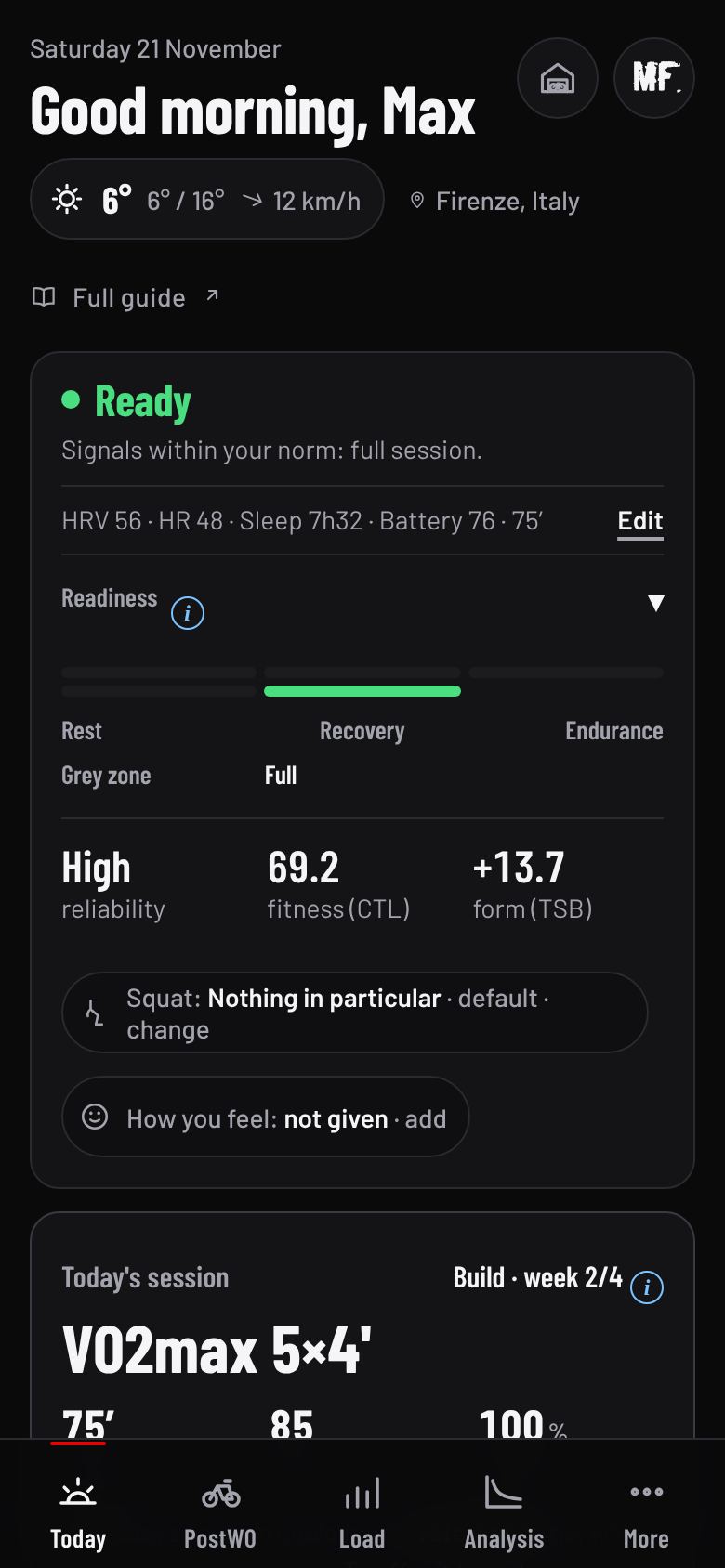
Every morning it tells you how well you have recovered and, from that, how much volume the day’s session gets. It looks at how far today you are from your own norm, not at other people’s numbers.
How it decides
- Personal norm: each signal is compared with your recent history and its own measurements, never with other people’s numbers.
- Overnight and morning HRV: if you have both the morning measurement and overnight HRV (watch or ring), both count, each compared with its own norm. With only the overnight device you don’t need to measure in the morning. If today’s measurement is missing, the source of the last measured day applies.
- Signal weights: HRV, resting HR, sleep, how you feel, your watch score (Body Battery, Readiness, Recovery) and form (TSB) carry different weights in the verdict.
- Outcome: for each marker your norm, the recent average and today’s value; each signal outside your norm weighs on the verdict. No alarm: “Ready”, full session. Mild alarms: “Grey zone”, full quality with the stop rule. Heavier alarms, or HRV below your norm for a few days: endurance today. An even lower picture: recovery; on the second day in a row: rest.
- Precautions: HRV far above your norm: no VO2max or anaerobic work and the verdict cannot be “Ready”; high HRV and high resting HR together, rest today.
- Reliability: it grows with the number of signals available.
- The squat: the markers measure autonomic recovery, not muscular recovery. A slow bodyweight squat is the inner ring: “Nothing in particular” is the default (green, “default”); when the Tank is empty, the ring turns amber, “to confirm”, and the answer is mandatory: you can’t continue without one.
- Overnight breathing: only a warning when it moves away from your usual. The verdict does not change.
Recovery markers
In Profile → “Recovery markers”, at the top, “The load of your rides”: always on, counted automatically from every ride. Below, the markers in three groups (“Highly reliable”, “Fairly reliable”, “Low reliability”): in each group first the ones that arrive by themselves, then those marked “(not automatic)”, to be measured every morning. You don’t need a highly reliable marker: with no devices, load, sleep and how you feel are enough. If you change markers, the norm is provisional for a few days only if a new marker lacks values in the diary.
Test your device
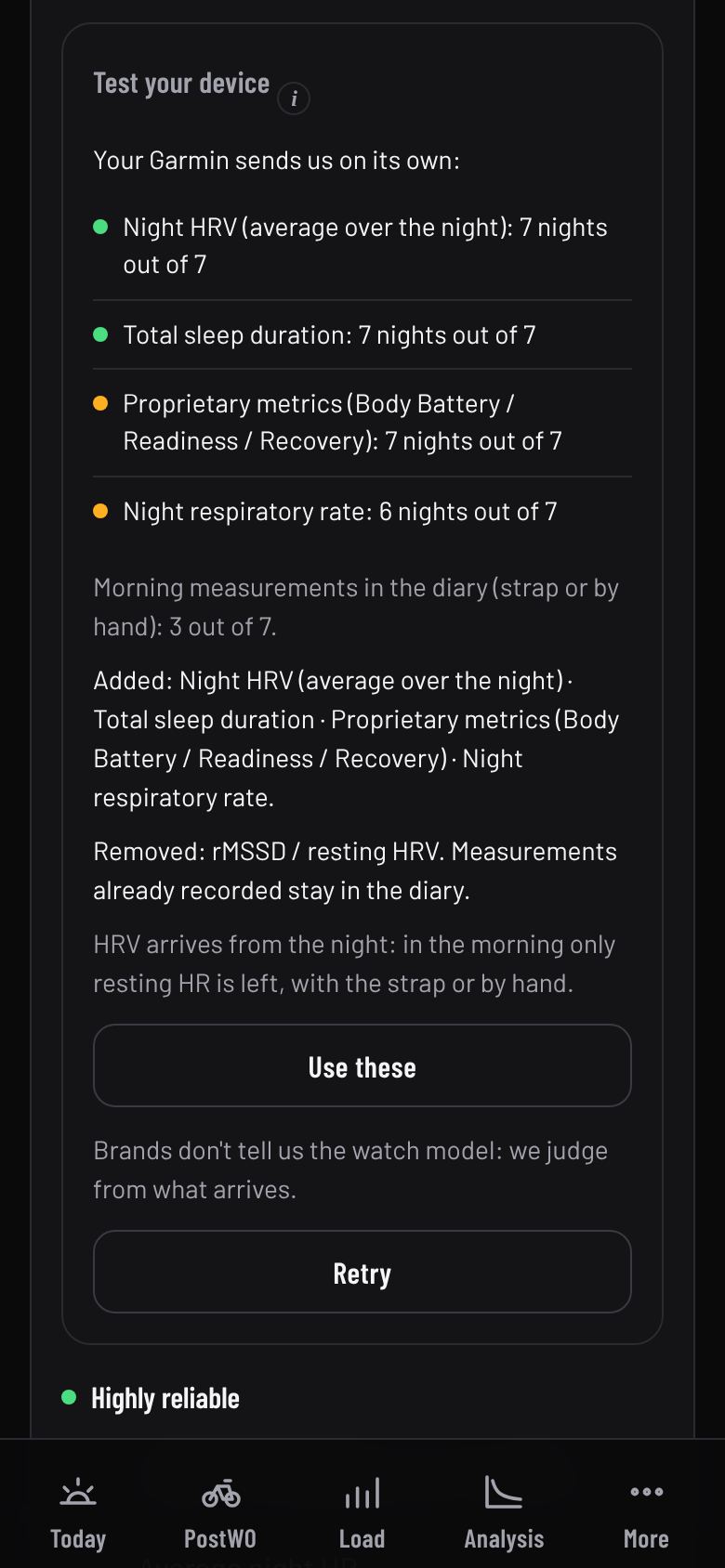
- It looks at the last 7 nights from each connected service (Garmin, Polar, intervals.icu, Health Connect) and shows, marker by marker, “n nights out of 7” or “not arriving”.
- It recommends what arrives regularly. It only adds: it removes just the morning measurement that the night replaces (rMSSD if overnight HRV arrives, resting HR if overnight HRV and HR arrive).
- “Use these” adds the markers and writes the nights already received into the diary, in the empty fields: as soon as there are enough values, the norm is ready and the verdict counts right away.
What you see in the app
If all your chosen markers arrive by themselves, when you open the app it imports the night and calculates verdict and session without you pressing anything. The opening screen has two rings: outside “Autonomic” from 0 to 100, inside “Structural” (the squat), in the centre “Ready”, “Grey zone”, “Endurance”, “Recovery” or “Rest day”, then “Go to the day”. On Today the verdict strip opens into “Readiness”.
How to do it
- Connect your device’s service in Connections and wear the device at night too.
- Open Profile → “Recovery markers” and tap “Test your device”.
- Read what arrives, what is added and what is removed, then tap “Use these”.
- With no connected services, pick your device and the app takes you to the right connection; “No device” offers “Add sleep and how you feel”.
Video
▶ Video coming soon: Antonio Petruzzi explains this feature.Sources
The numbers are those of the “i” in the app; tapping them opens the entry in the Bibliography.
[13] Plews DJ et al. 2013 · [14] Buchheit M 2014 · [15] Kiviniemi AM et al. 2007 · [16] Javaloyes A et al. 2019 · [17] Esco MR, Flatt AA 2014 · [18] Munoz ML et al. 2015 · [19] Saw AE et al. 2016 · [20] Fullagar HH et al. 2015 · [21] Morton RH et al. 1990 · [88] Miller DJ et al. 2020